August 2026 · cashier architecture, not payment logos
Best Bitcoin Casino Sites: rails built around settlement, not a logo
In brief
The best bitcoin casino sites listed here all take bitcoin, so that fact sorts nobody. What sorts them is how far the coin travels into the product: whether the deposit screen names a chain or offers a “payment method”, whether the balance can be read in coin as well as dollars, whether identity documents are collected while your balance is zero, and whether a payout heads back to the wallet that funded the account. Those are architecture decisions, and they were taken long before your withdrawal request existed. None of the five is licensed in Australia and none can be — the Interactive Gambling Act 2001 prohibits supplying online casino games to Australian residents and ACMA blocks sites that do.
The published windows below belong to the operators, not to any blockchain: Casinova (9.4) and Betwest (9.3) at 0–24 hours, Kingmaker (9.2) and Cleobetra (9.0) at 0–48, Betrepublic (9.1) at 24–72. Settlement after approval takes minutes everywhere. Betwest verifies up front so the paperwork cannot hold a payout; Kingmaker runs the smallest offer, which clears the cashier soonest; Betrepublic prints the network beside the address. Read those three lines and you have the whole comparison. 18+.
Callum Hedley · cashier architecture and settlement design · August 2026
Five offshore cashiers, sorted by how deep the coin goes
✓Chain named beside the address✓Balance readable in coin✓Documents collected before a balance exists✓Payout returns to the funding wallet
The casinos in our comparison
Kingmaker Casino
9.2/10
Bonus: 50 Free Spins + A$800
Kingmaker Casino is one of the best bitcoin casino sites here: a jackpot-heavy catalogue of roughly thirteen thousand seven hundred games that Canadian players can browse via a clean search bar and provider filter.
Gold Saloon live tables stream in high definition with multiple camera angles while the progressive jackpot ticker updates every few seconds above the reels. The lobby opens quickly on mobile browsers and keeps the same layout whether the device is held in portrait or landscape mode.
Casinova Casino runs under a Curaçao licence and is not regulated by any Canadian provincial gaming authority.
This offshore status lets the site accept Canadian players yet places any dispute outside the reach of local regulators or consumer-protection offices. The licence still mandates basic fairness testing and player fund segregation but Canadian visitors should be aware that enforcement would occur through the offshore regulator rather than a domestic body.
Cleobetra Casino supports familiar Canadian payment rails including Interac, credit cards and several e-wallets for both deposits and withdrawals.
The mobile site preserves full cashier access and keeps the same fast-loading lobby across Android and iOS browsers. No separate app is required and the last used payment method is stored for quicker future transactions, making on-the-go top-ups simple for Canadian users who prefer PayPal or bank transfer.
BetRepublic processes CAD deposits instantly through several e-wallets and turns most withdrawal requests around within twenty-four hours once identity verification is complete.
Card payouts normally arrive in three to five banking days. The KYC process asks for a single government ID on first withdrawal and rarely requires further documents unless the requested amount exceeds the operator’s standard threshold.
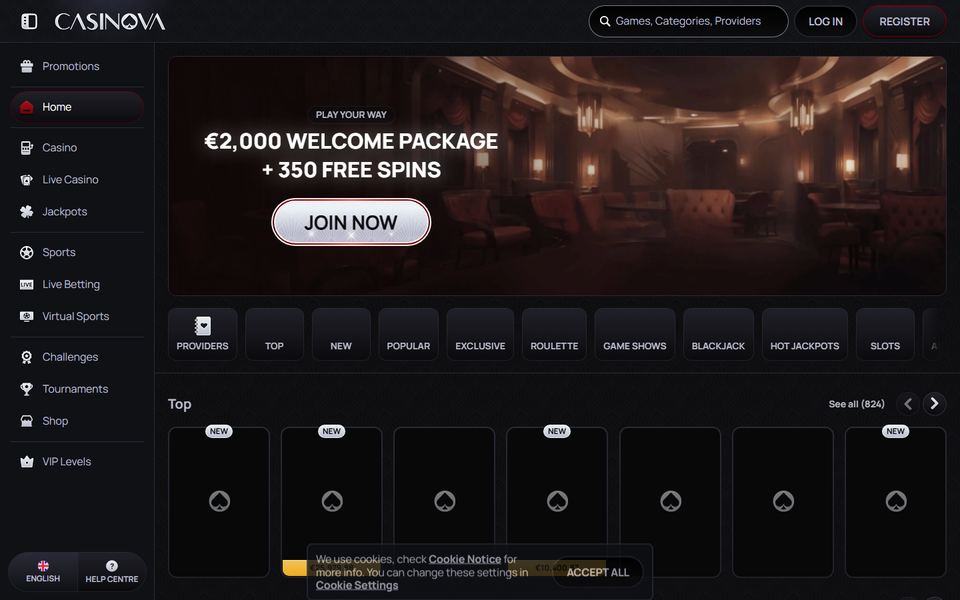
BetWest greets new players with a headline welcome package of five thousand euros plus three hundred fifty free spins spread across multiple deposits.
Each deposit stage demands a minimum twenty euros and every bonus portion carries thirty-five times wagering while free spins carry forty times. The maximum stake allowed during active bonus play is one hundred euros and any cash-out from bonus winnings is capped at ten times the total bonus received.
The six things that separate a native cashier from a retrofitted one
01
Whose name is on the network
Printed beside the address in the same weight, or hidden in a dropdown which defaults to whatever the processor integrated first. This is the only field in the sequence with no undo, so we record how hard the operator makes it to get wrong. A bitcoin casino that names the network beside the address has removed the one deposit error that no support team can undo.
02
One address, or a new one each time
A fresh address per deposit costs the operator nothing and shows the cashier is speaking to wallet infrastructure. A single permanent address handed back every session is the clearest sign a coin was added to a card ledger. A bitcoin casino player who reuses a deposit address cannot rely on it routing to the same account between sessions.
03
What the balance calls itself
We look at the confirmation screen. A dollar figure alone means the operator converted on arrival and took a spread you never saw quoted; a quantity of coin means the price movement is yours for as long as the funds stay there. The point is not which is better but whether you were given the choice.
04
Where the floor came from
A minimum expressed to the cent in fiat is a rule inherited from a card acquirer. A minimum expressed in the terms of the network the floor applies to was written by somebody who has watched dust transfers arrive. A bitcoin casino floor written in coin terms rather than fiat signals that the cashier was designed around the rail, not bolted onto it.
05
When the documents are asked for
Before you hold anything, or at the moment you try to leave with something. The work is identical either way. The leverage is not, which is why we treat up-front verification as a strength rather than a nuisance. A bitcoin casino that collects identity documents before any balance exists removes the leverage most commonly used to delay a payout approval.
06
Who is awake when the queue moves
Every published window is a human institution with shifts and weekends behind the queue, not a property of any chain. We note whether support covers the clock, and whether a first-line agent can answer a question about a chain without escalating the ticket to somebody who can. A bitcoin casino payout queue is a company institution; the on-chain broadcast takes minutes once an approval exits the queue.
Best Bitcoin Casino Sites: accepting coin, or building around settlement
Displaying a bitcoin symbol in the payments strip does not make an operator a bitcoin casino — accepting bitcoin as a payment method and building around the coin are two different products. Those two descriptions are not the same, and the distance between them is where an Australian player quietly loses spread, hours, and once in a while an entire transfer.
Coin acceptance is something a casino buys. A processor sells it as a module, the module bolts onto a cashier that was drawn around cards, and by the end of the week there is a fresh logo in the footer strip and a fresh row in the deposit dropdown. Nothing further has to change. The ledger still counts in cents. The withdrawal form still thinks in payment methods. The promotions engine still assumes a customer who tops up from a debit card on Friday and reappears the Friday after. A coin has been added to machinery built around a completely different set of assumptions, and every one of those assumptions survives the addition intact.
Something else happens when the coin comes first. The account has a native denomination that is not a national currency. Verification is arranged so that it happens while a balance is still zero, because the operator knows the customer came for the exit rather than the entrance. The deposit screen names a chain as a chain, and the withdrawal screen asks for a wallet rather than for a stored beneficiary. None of that is generosity. It is a company that understands that its product is settlement, and that a player who has been burned once on a rail does not come back to it.
Before any of the comparisons below mean anything, the legal position has to sit on the table. Not one of the five operators covered on this site is licensed in Australia, and none can be: the Interactive Gambling Act 2001 prohibits supplying online casino games to Australian residents, and ACMA maintains a blocking programme against sites that do. An Anjouan licence is an offshore licence. So is a Curacao one. Neither buys you an Australian regulator, an Australian dispute scheme or a place on a national exclusion register. Everything on this page is a comparison between offshore products for adults over eighteen who have already decided what they are doing.
What gives a retrofit away?
A retrofit casino cashier leaks its own history in small places — a balance that exists only in dollars, with no coin display — visible to any player who checks before depositing.
A balance that exists only in dollars, with no option anywhere to display it in coin.
A deposit floor written to the cent in a fiat figure, which is a number designed for a card processor rather than for a chain.
One deposit address, permanent, handed back unchanged every session.
A withdrawal flow that asks you to choose a payment method first and treats your wallet as a stored beneficiary afterwards.
Bonus terms that mention your card issuer and your banking method, written years ago and never reread by anybody who thinks in transactions.
The support desk is the strongest signal of all, and testing it costs nothing. Ask a question which only makes sense on a chain: what happens to a transfer that lands under the minimum, or whether an address stays valid between sessions. A cashier team which lives with crypto answers in a sentence. A card team routed a crypto ticket answers with a template about processing times and banking partners, then offers to escalate. That escalation is the tell. It means nobody on the first line has been given the vocabulary, which in turn means the operator does not expect enough of these questions to bother.
None of these are proof of dishonesty. A retrofit casino can be run by scrupulous people. What the tells measure is priority: how far down the roadmap the coin sits, and therefore how much attention your transfer gets when something about it is unusual.
And unusual is the word that matters, because the ordinary case works everywhere. Send the right asset on the right chain, above the floor, from a wallet you control, and every cashier on this page will credit you without drama. The differences only appear in the awkward cases: the transfer that arrived a fraction under the minimum, the address copied out of a note saved a month ago, the withdrawal requested to a wallet which is not the one that funded the account. Those are the moments when you find out whether the operator has anybody who understands what you are describing, and by then you are already inside.
A chain, or a payment method?
The green table still stands for the live casino floor.
Casino cashiers that treat bitcoin as one method among several cannot preserve the one field the blockchain corrects after every transfer. It is the abstraction that lets a product manager put a card, an e-wallet, a voucher and a blockchain into one table as interchangeable rows, and it is exactly the abstraction which destroys the one field in the whole flow that cannot be corrected afterwards.
A chain is not a method. A card number is checked, validated and reversible; a transfer broadcast on the wrong network is simply gone somewhere neither party monitors. So the operators which take this seriously print the network beside the address, in the same visual weight as the address itself. Betrepublic does exactly that, and it is worth more than most of what appears in its marketing, because it removes the only irreversible error available to a first-time depositor.
Fresh addresses are the second marker. Generating one per deposit costs the operator nothing and tells you the cashier is talking to a wallet infrastructure rather than to a spreadsheet row. The third is the return path: a payout that goes back to the wallet that funded the account, by default, without a form asking where you would like it instead. The fourth is verification you can finish before you hold anything. Betwest runs identity checks up front, and its own recorded strength is that this cannot then be used to hold a payout later. Deferring the same paperwork to the moment a win is sitting inside the account does not remove the paperwork. It relocates it to the point of maximum leverage.
The fifth marker is boring and matters more than the rest: staffing. Betwest keeps support on shift around the clock to work the payout queue, and a queue is a human institution. Chains do not sleep. Risk teams do.
Dollars in the account, coin in the wallet
An offshore casino holds the credited balance in dollars or in the original coin after a confirmed transfer, and only a dollar figure means the operator converted on arrival.
If the answer is a dollar figure and only a dollar figure, the operator converted on arrival, and the conversion happened at a rate that is its own. You will not carry any price movement while your funds sit there, which is genuinely useful, and you will pay for that twice, once on the way in and once on the way out, at a margin you never see quoted. If the balance can also be read as a quantity of coin, the operator has kept the asset as an asset, and the price move over your session belongs to you. Neither design is dishonest. Only one of them lets you decide which exposure you would rather hold, and that choice is a fair definition of the difference this page is about.
Watch what happens to the minimums under the same lens. A native cashier tends to express a floor in the terms of the network the cashier is quoting, because a floor exists to stop transfers too small to be worth handling. A retrofit quotes the same floor in dollars and cents, because the number was inherited from an acquirer's rules and nobody thought to rewrite the figure. That is a small thing that tells you a large one.
Betrepublic is worth a note here for a structural reason. A single crypto deposit funds both its sportsbook and its casino, so the coin arrives once and is spent against one balance rather than shuffled between two products. That is a decision about where the money lives inside the company, and decisions like that are what actually separate the operators on this page.
How fast can instant be?
A crypto casino payout is not instant at the operator: settlement after approval takes minutes, and every published window on this site is the company queue, not the chain. Settlement on a chain, once a payout has been approved and broadcast, takes minutes. That part is not the operator's achievement, and it is not where you wait. What you wait for is a queue inside a company, and every published window on this site is exactly that queue and nothing else.
Casinova Casino and Betwest Casino both publish 0 to 24 hours, the shortest here. Casinova sits at 9.4 with a Curacao licence and A$3,200 plus 350 free spins; Betwest at 9.3 with an offshore licence, A$8,000 plus 350 free spins and the largest library of the five at 3,000+ titles.
Kingmaker Casino and Cleobetra Casino both publish 0 to 48 hours. Kingmaker carries the top score here at 9.2 on an Curaçao licence with A$800 plus 50 free spins, the smallest offer on the page; Cleobetra sits at 9.0, also Anjouan, at A$1,600 plus 350 free spins.
Betrepublic Casino publishes 0 to 12 hours, level with Casinova and behind only Cleobetra, at 9.2 on an Anjouan licence with A$3,200 plus 200 free spins.
Read that as a statement about companies rather than about technology and it becomes informative. An operator shortens its own queue by removing reasons for a person to open the file: documents already cleared, no bonus still live against the balance, a destination address that matches the one the money came from. Every one of those is an architectural choice made long before your withdrawal request arrives. The operators that made those choices early are the ones whose windows are short, and the causation runs in that direction rather than the reverse.
None of which is a promise. A published window is what an operator intends to do, not what it owes you, and there is no Australian body that could make it owe you.
Why price a bonus differently for coin players?
The green table still stands for the live casino floor.
A card-first casino builds its welcome offer around a habit. The customer funds from a bank account, the bank imposes friction, the friction makes each deposit a small decision, and the offer exists to make that decision easier and to keep the account warm between paydays. Size the bonus generously, spread it across several deposits, and keep it attached to the balance for as long as the terms allow.
Now run the same maths for someone who arrived with a wallet. That customer can fund in ninety seconds at three in the morning without asking anyone's permission, so the entrance needs no lubrication at all. What they are actually evaluating is the exit. Which reframes a large offer entirely: a bonus that stays live against a balance is the most common reason a withdrawal is refused outright rather than queued, so for this customer a generous package is a lock fitted to the door they came to test.
Kingmaker's smallest-on-the-page offer reads as a weakness in a table and behaves as the opposite in a cashier, because a modest bonus clears sooner and hands the balance back. Betwest is the interesting case, because it holds both logics at once: the fastest queue on this page and an A$8,000 package that stays live and can sit across a cashout. Those two features came from different departments, and you can pick which one you want by simply declining the offer.
The other half of this is the terms document. On a retrofit it was written for card players, and nobody has reread it since the coin arrived. That is where you find rules about your banking method, and no rule at all about what happens if the asset you deposited is worth ten per cent more on the day you withdraw.
One coin, or a wall of tickers?
A bitcoin-only casino operator is making a real trade and the trade is worth understanding both sides before treating the single-asset cashier as a limitation.
What you gain is a product with one address format, one network label, one support script and one class of mistake. Wrong-network losses, which are the only truly unrecoverable error in the whole flow, become close to impossible when there is only one network on offer. The cashier can be written once and properly. The people answering tickets see the same five questions all day and can answer them without escalating.
What you give up is optionality, and specifically the dollar-pegged option. Without a stable rail, every hour your funds spend in a payout queue is an hour of price exposure which you did not choose and are not being paid for, and at 24 to 72 hours that stops being a rounding error. You also give up the ability to route around congestion on the base layer, because there is nowhere else to go.
There is a middle position which most of the field occupies, and the arrangement deserves naming rather than sneering at. Casinova takes coin alongside cards and e-wallets, which is not a purist arrangement and is a practical one: it lets you fund with an asset and still watch how the operator behaves before committing to coin as your only route in. A cashier that supports both rails has to keep two sets of habits honest, and the interesting thing to watch is which of the two the interface was clearly drawn for.
So the useful question is not how many tickers a cashier lists. A long list assembled by a processor is a longer menu of ways to get the network field wrong. The useful question is whether every entry on the list names its own chain on the screen where you send. One coin done properly beats nine done as rows in a table, and nine done properly beats one, and the number itself tells you nothing.
Why is the footer badge the cheapest thing here?
Every casino on this page carries a licence badge somewhere near the bottom of the page, and the badge is the least expensive pixel on the entire site. The badge costs nothing to display, is issued a long way from you, and answers none of the questions that decide whether you get your money back: how long the queue runs, whether the address is fresh, what denomination the balance is held in, whether the paperwork was collected while your balance was zero.
For an Australian reader that badge is a negation before it is anything else. Offshore means no ACMA-regulated site, no Australian complaint which goes anywhere, no local dispute scheme, no national self-exclusion register reaching the account. That is true of all five here, equally, whether the badge says Anjouan, Curacao or nothing much at all. Which is precisely why the badge cannot be the thing you compare on, and why the cashier has to be.
One last mechanical point which belongs at the end rather than the beginning. A bank card can decline you, and a bank can apply a gambling block, and for a lot of people that refusal has been the thing which ended a session. A wallet does not decline, does not close, and does not care what hour it is. On this rail the brake is not in the plumbing, so it has to be a number you set before the first transfer, and the honest way to test any cashier described above is with an amount whose loss you would find annoying rather than serious.
Eighteen and over. Gambling can be addictive and no payment rail changes the house edge. Free and confidential help in Australia: Gambling Help Online on 1800 858 858.
Where each cashier is native, and where it is bolted on
Kingmaker Casino
License Curaçao · 9.2/10
Pros
Coin deposits and cashouts sit alongside the conventional rails
0–48h is the operator queue; the chain finishes in minutes
Smallest offer on the page, so the cashier is clear soonest
Cons
Not licensed in Australia (Curaçao licence)
Limit increases take effect with little cooling-off, and no bank sits in the middle of a coin transfer
Casinova Casino
License Curaçao · 9.4/10
Pros
Joint-shortest operator queue here at 0–24h
A short queue is a short window of price exposure
Coin accepted alongside cards and e-wallets
Cons
Not licensed in Australia (Curaçao licence)
No dedicated app, so addresses move between a wallet and a browser tab
Cleobetra Casino
License Anjouan · 9.0/10
Pros
The chain is printed beside the deposit address
0–48h is internal handling; settlement after approval is minutes
Best-built interface of the five
Cons
Not licensed in Australia (Anjouan licence)
Smallest game catalogue of the five
Betrepublic Casino
License Anjouan · 9.1/10
Pros
A single coin deposit funds both the sportsbook and the casino
One network fee and one payout queue instead of two
A deposit limit applies across the shared balance
Cons
Not licensed in Australia (Anjouan licence)
Longest operator queue of the five at 24–72h, and the price exposure runs alongside it
Betwest Casino
License Offshore · 9.3/10
Pros
Documents collected up front, so they cannot be used to hold a payout
0–24h operator queue, then minutes on the chain
Largest library here: 3,000+ titles
Cons
Not licensed in Australia (offshore licence)
A very large offer that stays live and can stand across a cashout
What each rail typically asks for, and where it caps you
Rail
Typical minimum deposit
Typical withdrawal ceiling
Bitcoin (BTC)
A$20 equivalent
Often uncapped; large payouts reviewed by a person
Ethereum (ETH)
A$20 equivalent
Often uncapped; large payouts reviewed by a person
Stablecoin (USDT / USDC)
A$20 equivalent
Often uncapped; the rail which removes price movement
Litecoin (LTC)
A$20 equivalent
Often uncapped
Cards (Visa / Mastercard)
A$10–20
A$5,000 per day
Skrill / Neteller
A$10
A$10,000 per day
Bank transfer / POLi / BPAY
A$20
A$10,000 per day
Paysafecard / Neosurf
A$10
Deposit only — cannot be used to cash out
Four minutes before the first transfer
At an offshore casino, read the deposit screen for a chain label, generate a fresh address, check what the balance calls itself once credited, and send an amount without staking more than you can afford to lose.
Ran the KYC checklist before depositing anywhere. Two of the three sites I tested asked for a utility bill within 48 hours of signup — caught early is better than caught at cashout time.
Paige D.
11 Aug 2026
The argument which deferred ID just moves the paperwork to exit time is the most honest thing I’ve read on this. Changed which account I opened.
Kade M.
8 Aug 2026
Solid on why a large welcome package can work against a fast withdrawal. Would like a guide on what a support desk answer should look like when you push on something awkward.
Vera N.
5 Aug 2026
The point about a footer licence badge being the cheapest thing on the site is uncomfortable and accurate. I had been treating it as a payout guarantee rather than a registration record.
Callum Hedley
Cashier architecture and settlement design
Last updated: 15 August 2026
This site asks one question of an offshore casino and refuses to be distracted from it: how much of the product was actually built around the coin, and how much of it is a card cashier wearing a bitcoin logo. That means reading the deposit screen for a chain label, checking whether a balance can be denominated in anything but dollars, noting where a deposit floor was inherited from, finding out whether identity documents are collected before or after you have money inside, and watching whether a payout is allowed to return to the wallet that sent it. We do not review game software and we do not quote a network fee, because the first is outside our competence and the second is an auction price that is stale by the time it is typed.
What we open a cashier to find out: Deposit screen read for the network label, its prominence, and whether a fresh address is issued per transfer. Confirmation screen read for the denomination of the credited balance. Deposit floor checked for whether it was written for a chain or inherited from a card acquirer. Verification trigger recorded as sign-up or first withdrawal. Withdrawal flow checked for whether it asks for a wallet or for a stored payment method, and whether the funding wallet is the default destination. The operator's published processing window recorded and kept strictly apart from on-chain settlement, which is minutes once a payout is approved. Support tested with one question that only makes sense on a chain, and the answer graded on whether it needed escalation.
Disclosure: reviewed November 2026. Some outbound links pay this site a commission when a reader registers, and that commission has no effect on a score, a ranking or a published processing window. It also cannot make an offshore operator licensed in Australia, because no operator can be. Crypto transfers are final and cannot be reversed or charged back. Nothing here is financial or tax advice. 18+ only; gambling can be addictive. Free, confidential help: Gambling Help Online or 1800 858 858. Callum Hedley is the editorial byline of this site — a pen name under which the site publishes, not a claim about a named individual, their employer or their qualifications.
What these cashiers will take from Australia, coin rails first
These bitcoin casino sites accept coin rails and traditional payment methods, listed coin-first because the chain a cashier names beside the deposit address is the most consequential field on the screen.
Bitcoin (BTC)Ethereum (ETH)Tether (USDT) — dollar-peggedUSD Coin (USDC) — dollar-peggedLitecoin (LTC)VisaMastercardSkrillNetellerPaysafecard / Neosurf (deposit only)Bank transfer / POLi / BPAY
Sorted by the thing you actually want from a cashier
Groupings follow what is recorded about each operator, not what its front page says about itself
Fewest hands between you and the exit
Published windows of 0–24 hours, with verification already cleared in Betwest's case and a desk staffed around the clock to work the queue
These questions cover the screens that reveal whether the best bitcoin casino sites were built around settlement or retrofitted from a card cashier. A bitcoin casino site that passes these tests was designed for coin from the ground up, not adapted after the fact.
How do I tell a bitcoin-native cashier from one which merely accepts bitcoin?
Four screens on a bitcoin casino answer the test. The deposit screen either names a chain beside the address or offers you a payment method. The confirmation screen either lets you read the balance in coin or only in dollars. The withdrawal screen either asks for a wallet or asks you to pick a stored method. And the terms document either mentions transfers or still talks about your card issuer. A cashier that fails three of the four was built around cards and had a coin added later.
Is a permanent deposit address actually a problem?
A reused address is a signal more than a hazard. Issuing a fresh address per deposit costs an operator nothing and indicates the cashier is connected to wallet infrastructure rather than to a spreadsheet row. A single reused address suggests the opposite, and an address you saved months ago may or may not still be attributed to your account. Generate a new one every time the option is offered.
The withdrawal form calls my wallet a payment method. Does this matter?
That wording tells you the abstraction the product was designed around. Cards, vouchers and chains sit as interchangeable rows in one table, which is convenient for the developer and dangerous for you, because the field which cannot be corrected after the fact is the one the abstraction hides. The wording does not mean the payout will fail. The design never treated your transfer as different from a card refund.
Why is the deposit floor quoted to the cent in dollars?
Because the floor was almost certainly inherited. Card acquirers impose fiat minimums and those numbers get carried straight across when a coin module is bolted on. A floor written for a chain exists to stop transfers too small to be worth handling, and an operator which thinks in those terms tends to express the floor that way.
What should I ask support before depositing anything?
Ask something which only makes sense on a chain: what happens to a transfer which lands under the minimum, or whether a deposit address stays valid between sessions. A desk which lives with crypto answers in one sentence. A card desk answers with a template about processing times and offers to escalate, and the escalation is your answer.
Does a bitcoin-only operator beat one that lists a dozen coins?
A bitcoin-only desk trades one thing for another. A single chain means one address format, one label to check and effectively no wrong-network losses, which is the only unrecoverable mistake available to you. The same desk also means no dollar-pegged option, so every hour spent in a payout queue is price exposure you are not being paid to hold. The useful test is not how long the list is, but whether every entry on the list names its own chain on the screen where you send.
Does the licence badge in the footer say anything about the cashier?
Almost nothing, and the badge is the cheapest element on any casino page to display. The badge does not describe queue length, address handling, balance denomination or when documents are demanded. For an Australian reader the badge is a negation before anything else: offshore means no ACMA-regulated site, no local dispute scheme and no national self-exclusion register reaching the account.
Why would an operator built around bitcoin offer a smaller bonus?
Because the operator knows what the customer is buying. A card-first casino uses a large package to reduce the friction of the next deposit; a coin depositor has no friction at the entrance and is judging the exit instead. A bonus that stays live against a balance is the most common reason a withdrawal is refused outright rather than queued, so a smaller offer resolves sooner and hands the account back. Kingmaker's is the smallest here for exactly that reason.
Which of the five collects identity documents before I have a balance?
Betwest runs verification up front, which is the reason its own recorded strength says the check cannot later be used to hold a payout. Where verification is deferred, the same request arrives at the withdrawal instead, which is the moment your money is inside the account and your patience is worth the least.
Can a retrofitted cashier still pay me out properly?
Yes, and most of the time a retrofitted casino cashier will. The ordinary case works everywhere: right asset, right chain, above the floor, out to the wallet that funded the account. Architecture shows up in the awkward cases instead, and none of these operators is licensed in Australia, so there is no local body to arbitrate one. Keep the amounts inside the range where that answer is tolerable. 18+; free help on 1800 858 858.
We use technical cookies to ensure the website works properly. By continuing to browse, you accept the use of cookies.